Make it exist first: how project fable is changing the way we build forecasting models

A pottery teacher once split his class in two.
One group was graded on quantity. As many pots as possible, judged only by the pile at the end of term. The other group was graded on quality. One pot. It had to be perfect.
When the term ended, the best pots in the room all came from the quantity group. Not one came from the perfectionists.
The story is from the book Art & Fear, and it gets told often enough that it's become a cliché in some circles. Despite that we still think it has something important to say, and it captures something we're thinking – and doing – in data & forecast. Our markets and the technology underneath it move faster than they used to, and our customers need our know-how in their hands sooner rather than later.
The question is how can we update our ways of working to get the great forecasts and ideas we have into the hands of our customers, faster? Even if it isn’t perfect today?
For a long time, our approach to building forecasting models looked more like the perfectionist group in that classroom. It served us well when the ground underneath us moved more slowly.
A new model idea would surface. The team would sit with it, refining, back testing, chasing down every edge case before it saw a single real customer. This took time – but that was OK, as it meant that what we built would serve us well for many years to come. But recently the world underneath this approach has moved. Our markets are shifting rapidly. Our customers’ needs are changing. All this is exacerbated by AI. The risk is now that we build for a problem that has changed (or even worse, been solved) by the time we are ready for release.
That's not a story about us doing something wrong. It's a story about pace, the market and the technology moving faster today than before, and where rigor alone doesn't get know-how into a customer's hands any sooner.
Project fable is step one in building an answer to that shift in pace.
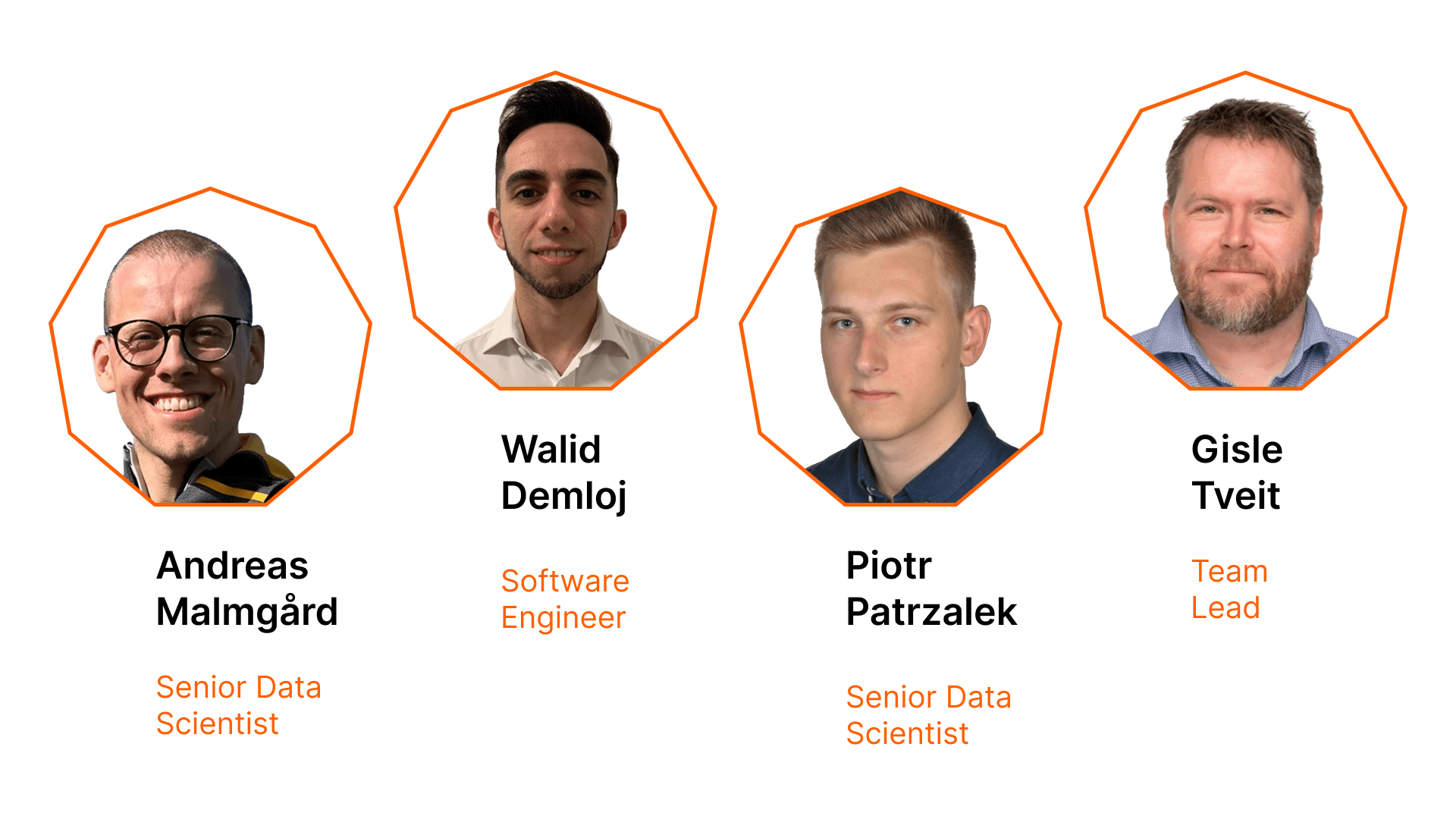
The premise is simple: the team: Andreas Malmgård, Walid Demloj, Piotr Patrzalek, and Gisle Tveit, had 14 days to ship a working unscaled consumption forecasting model. Not a perfect one. A pretty good one, live in production, delivering real value immediately.
Instead of one model refined in isolation, the team builds candidates fast, tests them on real data, and pushes the winner into production (yes, as a beta version at first). This tells them, immediately and unambiguously, what works.
Here's what that shift buys us:
Reps beat theory. You cannot think your way to a skill or a model you've never tested against reality. Every cycle the model runs in production, the next version gets easier to build; a team shipping regularly and often develops instinct and product that shipping once every now and then never gets the chance to.
Production teaches you what staging can't. That's not a knock-on staging or dev testing, they genuinely catch real problems, and this project relied on them too. But some things only show up under real load, from real customers, over real time. That's what production adds on top of testing, not a replacement for it and it's why getting a model live sooner, responsibly, matters.
Volume finds the winner. Nobody bet the outcome on a single model being right on the first try. The team built and tested multiple candidates against real data before choosing which one to run, the same logic as grading a class on the whole pile of pots instead of the one someone swears is perfect in advance. You find your best work by making enough of it to compare.
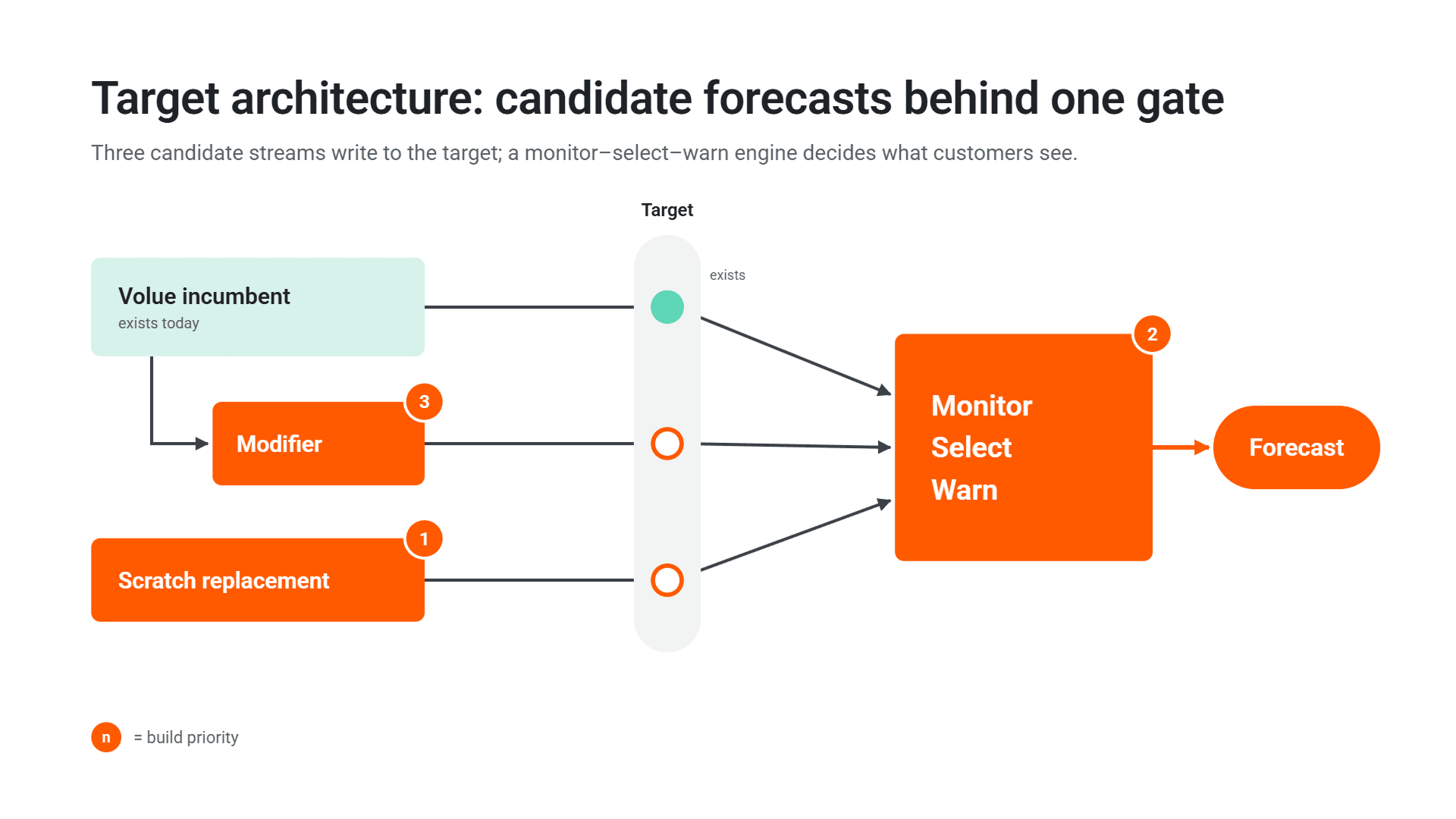
In practice, "ship something real in 14 days" didn't mean picking one untested model and hoping. It meant building and testing several candidates against real consumption data before deciding what actually goes into production:
The incumbent. The Volue forecast already in production is the baseline every candidate had to beat.
The modifier. A layer that adjusts the existing forecast rather than replacing it outright, a faster, lower-risk way to test improvements against the baseline.
The scratch replacement. A new model built from the ground up, starting with EU & JP unscaled consumption, then deterministic weather, scenario-based weather, and the fastest-refreshing grid-point model.
The original plan was a gate that would route customers dynamically between all three, picking whichever candidate performed best day to day. Testing told a different story: for this case, that complexity wasn't earning its keep. The team picked the strongest performer and put that single model into production for all predictions, simpler than the gate design, and the better call once the data was actually in front of them. Exactly the kind of thing 14 days of testing surfaces that months of planning wouldn't have.
The work was scoped as one 2-week sprint: build the candidates, test them against real data, choose a model, and get it into production. What the comparison showed is now shaping how the approach carries over to new markets and products.
Worth being precise about what "in production" means here. Two weeks got a working model live and taking real predictions, that part is true, and it's the headline. It doesn't mean the project completed Volue's full Software Development Life Cycle (SDLC) process end to end in that window; some of that work is still being finished, and more will follow before this is treated as a fully hardened production system. The speed is real. It's speed in building, testing, and choosing a model, not a shortcut around SDLC.
"This is exactly the pace shift the market is asking for. The world we are building forecasts to moves faster than it used to and our customers deserve our know-how sooner than later. Gisle, Walid, Piotr, and Andreas didn't just hit a 14-day deadline, they proved the model works: get something real in front of production, let the data tell you what's wrong, and fix it from there. I'm fully behind this approach, and I want to see more of Data & Forecast working this way. Great job, team."

Perfect conditions never arrive. You cannot plan your way to a good forecasting model, you make your way there, one 14-day sprint at a time.
That's the bet Project Fable is making, and the mindset we want to spread further across Data & Forecast: ship the rough version, let it exist in the real world, and let the real world tell you how to make it good. Make it exist first, make it great later.

Get accurate, price-area-level forecasts of wind, solar, consumption, and residual load, plus conventional production (thermal and nuclear), cross-border flow actuals, and hydrology, across Europe and Japan.
Energy Market Data & Forecasts