Why short-term production planning is harder than it used to be — and what to do about it
For production planners and energy managers running complex, multi-asset portfolios, this is the daily reality.
Published
May 4, 2026

For production planners and energy managers running complex, multi-asset portfolios, this is the daily reality.
Published
May 4, 2026
Every hour counts in today's power markets. With shorter gate closures, weather-driven price swings, and the need to participate simultaneously in day-ahead, intraday and multiple reserve markets, the window for getting your production schedule right has never been tighter — and the cost of getting it wrong has never been higher.
For production planners and energy managers running complex, multi-asset portfolios, this is the daily reality. A hydropower cascade with constrained water values, a thermal unit with start-up ramp limits, a battery with state-of-charge boundaries, and a wind farm with uncertain output — each asset follows its own physics, its own market logic, and its own set of obligations. Trying to optimise all of them together, in time to meet market deadlines, with data spread across different systems and tools, is a problem that spreadsheets and single-asset models were never designed to solve.
The consequences of fragmented short-term planning are well understood by anyone who has lived through a missed intraday window or a reserve shortfall. When production planning, reserve allocation and intraday re-optimisation run in silos, the portfolio behaves like a collection of independent parts rather than a coordinated system. Flexibility is underutilised. Bids are misaligned. Imbalance volumes climb.
The root cause is often not a lack of expertise — it is a lack of the right model. Most legacy tools were built for a simpler market structure, optimising a single asset class or a single market horizon. As portfolios have grown in complexity and markets have fragmented, these tools have been patched, supplemented with manual steps, and surrounded by workarounds. The result is a planning process that is slow, error-prone, and difficult to scale.
Volue Smart Power approaches short-term production planning as a single, unified optimisation problem. Rather than running separate models for hydro, thermal and batteries and then manually reconciling the outputs, Smart Power's multi-asset optimisation engine — Optimal Multi Asset — calculates coordinated, feasible schedules across the entire portfolio in one run.
This means water values are accounted for alongside battery state-of-charge, thermal ramp constraints are respected alongside reserve obligations, and the combined output represents a production plan that is both physically executable and financially optimised. For hydro-dominated portfolios with complex cascade structures, the SHOP Connector brings in SINTEF's hydropower optimisation model, enabling detailed modelling of water flows, reservoir levels and inter-unit hydraulic dependencies.
The result is a schedule that answers the question your trading desk actually needs answered: given what we know right now — prices, forecasts, constraints and reserve requirements — what is the best way to run these assets for the next 24 to 72 hours?
Short-term optimisation is not a one-time daily calculation. It needs to run continuously as prices update, forecasts change and events occur. Smart Power's Automation Framework handles this by triggering re-optimisations based on events — a new price curve from the exchange, an updated wind forecast, a TSO message, a change in asset availability — so that the production plan always reflects current information without requiring a planner to manually initiate each run.
For asset owners managing fast-moving assets such as batteries, this level of automation is not optional. It is a prerequisite for participating effectively in intraday and balancing markets, where decisions must be made in minutes, not hours.
NTE, a Norwegian renewable energy producer generating approximately 4.8 TWh annually, runs Smart Power for production planning and inflow forecasting across its hydropower portfolio. By modelling its assets in Mesh — Smart Power's object-based data management layer — and connecting automated workflows, NTE has established a foundation for accurate, data-driven scheduling that scales with its operational complexity (read more).
“Data structure is crucial as we move into new reserve markets and 15 minute MTU that further enhances the optimisation complexity. Smart power, with the MESH object modeling as a strong foundation, Automation Framework as ‘the spider in the web’, and the MESH API that connects us to external sources, has made us ready for the big market changes that as we speak are being implemented.”
Edvin Schubert, Production Planner at NTE.
For multi-asset producers, the financial case for better short-term optimisation is direct. More accurate scheduling means less imbalance exposure. Better reserve allocation means more value extracted from flexible assets. Coordinated multi-asset optimisation means the portfolio earns closer to its theoretical maximum rather than its practical average.
The shift from siloed tools to an integrated optimisation model is not a technology upgrade for its own sake. It is the operational foundation for competing effectively in markets that increasingly reward speed, accuracy and flexibility.
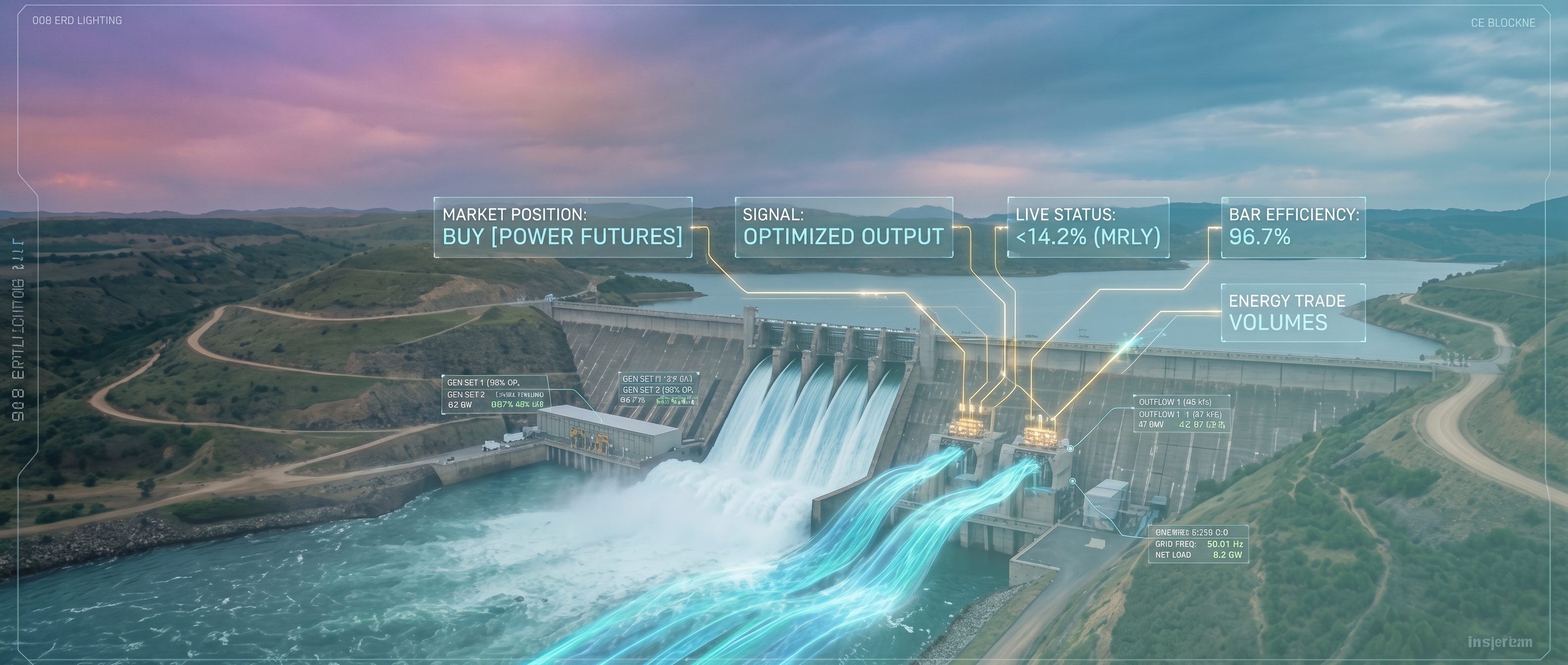
Volue Smart Power unifies multi-asset optimization, production planning, and automated trading workflows - so power producers can turn market volatility into a competitive advantage.
Energy Production Planning Software