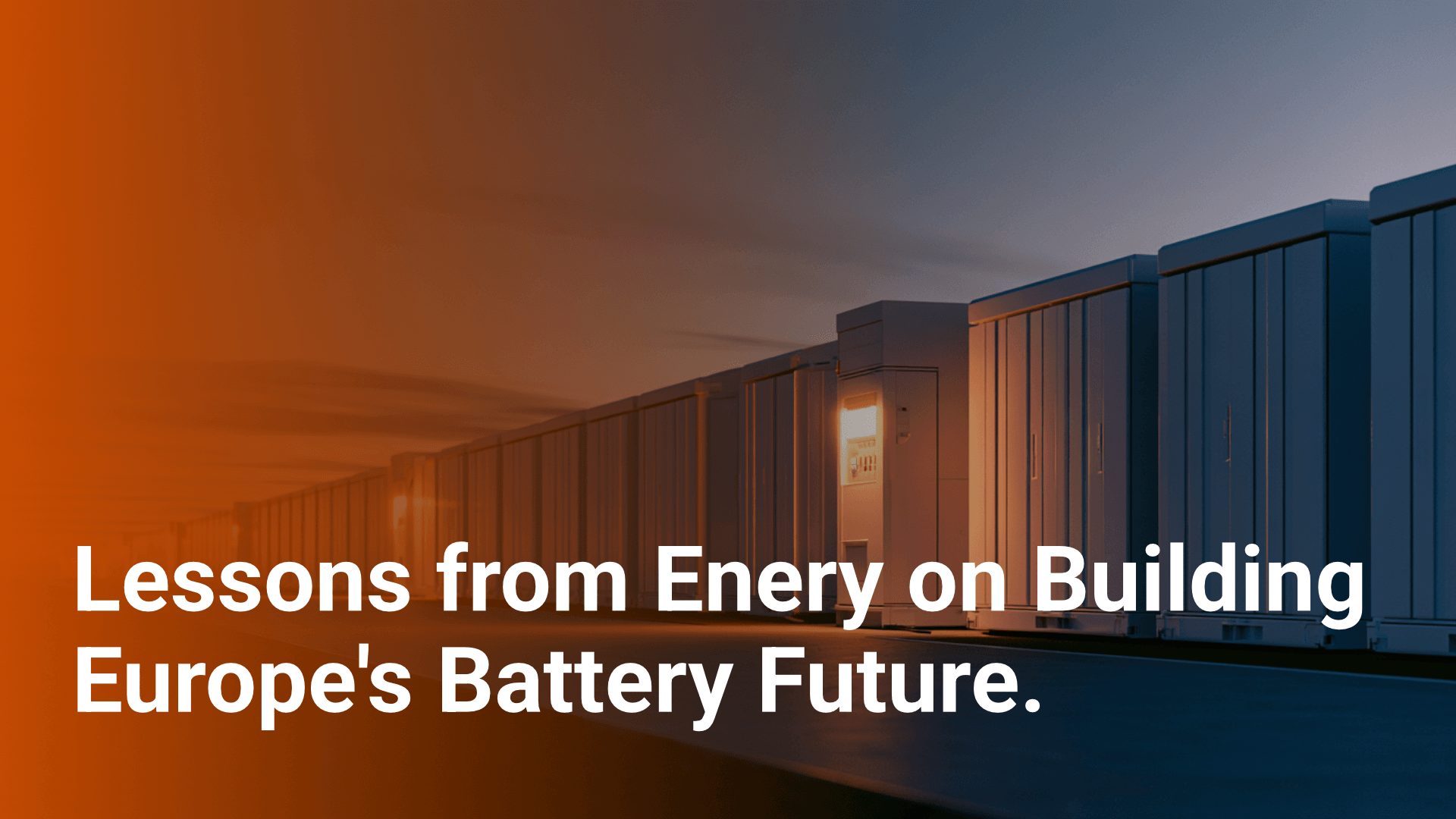
Europe added clean capacity faster than any grid was built to absorb it. The next phase will be won on a different metric: flexibility. The ability to store, shift, and trade renewable power is becoming the constraint that decides which projects earn a return and which markets scale.
At Volue's recent extended leadership team meeting, CMO Natasha Adams sat down with Petya Dimova, Head of Power Trading at Enery, for a fireside chat on battery storage, market flexibility, AI, and the future of energy trading. Enery is one of Europe's fastest-growing renewable players, and it operates on both sides of the market: as an owner of assets and as a trader. That dual view shaped the conversation.
Renewable generation keeps growing across Europe. Variability grows with it. Systems that once ran on predictable baseload now have to absorb swings in supply, and battery storage is emerging as the primary tool to manage them.
Dimova put the point plainly.
The evidence is already on the ground. Drawing on Enery's experience across Central and Eastern Europe, Dimova pointed to Bulgaria as a model for how fast storage scales when the surrounding ecosystem works. Streamlined permitting, strong financing structures, and a growing network of service providers moved projects from concept to operation at speed.
Flexibility assets do three jobs at once. They balance the grid, optimize renewable output, and cut exposure to volatile prices. In markets with rising renewable penetration, that combination is no longer a differentiator. It is the entry ticket.
Most traders sell a service. Enery also owns the assets, so it understands what keeps investors awake.
"We know very well what is important for investors" Dimova explained. That perspective, built as a developer and investor, shapes the commercial solutions Enery offers its customers.
The result is a toolkit designed to take risk off the table: tolling arrangements, profit-sharing models, spread hedges, and hybrid structures that combine fixed revenue with market participation. These structures help projects secure financing while keeping a path to additional market value.
Battery economics keep improving. Uncertainty remains. Investors want partners who can balance a stable revenue base against exposure to the upside, and they watch the merchant tail closely.
No two trading days look alike. Prices move, regulations shift, generation patterns change, and markets grow more interconnected by the quarter. The teams that adapt fastest capture the value.
Harmonization across Europe is advancing, yet local differences still dominate the operating reality. Transmission system operator requirements, exchange rules, and operational processes vary country by country. For a company expanding across borders, that fragmentation is a permanent tax on scale. Enery's growth depends on navigating it while keeping one efficient operating model. For any business spanning generation, storage, and trading, speed of reaction has become a competitive advantage in its own right.
Ask where AI moves the needle in trading, and Dimova goes straight to the decision layer.
Today, AI already earns its place in analysis and operational support. It cuts manual workload and helps teams process information faster. The larger prize sits upstream, in forecasting itself.
Forecasting drives everything downstream: generation planning, market positioning, asset optimization. Sharper prediction across prices, generation, weather, and market dynamics flows directly into trading performance and investment returns. AI is not replacing traders. It is changing how energy organizations operate, and the gains compound as models gain access to larger datasets and stronger reasoning.
The sharpest takeaway had nothing to do with technology. Asked what matters most at Enery, Dimova's answer was one word: trust.
Across renewable developers, battery investors, and energy consumers, Enery builds long-term partnerships that create value on both sides. Its rapid growth rests on the confidence customers place in those relationships. Technology remains essential. Sustainable growth depends on pairing it with deep market expertise, operational discipline, and strong partnerships.
Europe's energy transition has moved past the capacity question. Success now depends on combining storage, forecasting, AI, and market flexibility into systems that are smarter and more resilient. For Enery, that means investing in flexibility, adopting new technologies, and building partnerships grounded in trust. For the wider industry, the message is the same: the organizations that combine technology, intelligence, and collaboration will lead the next phase.
As Petya Dimova put it, "It's just the beginning." The next phase of the transition will be defined by clean energy, and by the flexibility and intelligence that make it work.
Head of Power Trading, Enery
Petya Dimova leads power trading at Enery, one of Europe's fastest-growing renewable energy companies, with a portfolio spanning renewable generation, battery storage, and trading across Central and Eastern Europe. She works at the intersection of asset ownership and market execution, shaping the commercial structures that help storage and renewable projects secure financing and capture market value.
Connect with Petya on LinkedIn.

Go deeper: the economics behind the transition
The whitepaper, From Asset to Algorithm: The New Economics of Battery Trading in Europe, unpacks how flexibility, forecasting, and cross-market optimization are redrawing battery revenue across Europe's power markets, and what it takes to stay economically viable as merchant exposure grows.