How BESS bids shape German day-ahead prices
13.4 M€ of net cash flow. And one decision behind every euro of it: the limit price.
Batteries now bid into the German day-ahead auction every day, with their own order type and their own logic. To see exactly how, we analyzed the EPEX SPOT order books out of Euphemia and conducted a deep dive into the so-called loop orders, often used by BESS operators to secure their margin in the day-ahead auction.
Loop orders: two legs, one test
Loop orders link a buy block and a sell block. EPEX SPOT describes them as a way to bundle buy and sell blocks to reflect storage activities. The battery charges on one leg and discharges on the other.
In loop orders, the limit prices of the two legs are tested together rather than one by one. A pair is accepted when its combined surplus is zero or positive. This means the revenue of the sell leg minus the cost of the buy leg at the clearing prices must reach the same difference computed at the two limit prices.
We analyzed data of German merit orders from January 1 to November 16, 2026: in this analysis some main observations.
The chart below shows, in MW, the average of the offered and accepted pairs, with volumes split between sell and buy. We observe that, on average, the loops buy at night and around midday and sell into the morning and evening peaks.
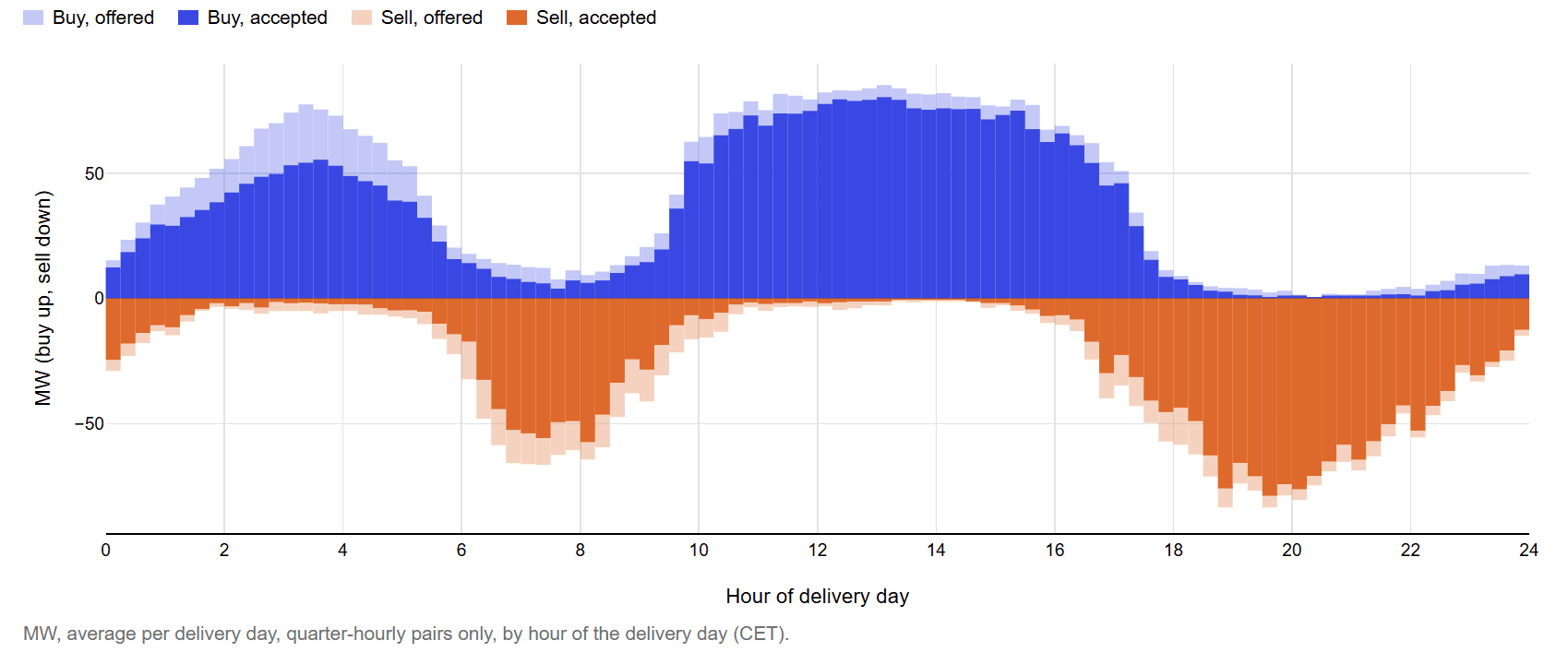
Germany: average quarter-hourly loop volume per day in 2026.
Short and sharp: how the pairs are shaped
Half the pairs discharge for 30 minutes or less, and most sell between 0.70 and 0.80 MWh per MWh bought. Since the move to 15-minute products, loops can target the sharpest quarter hours of the day.
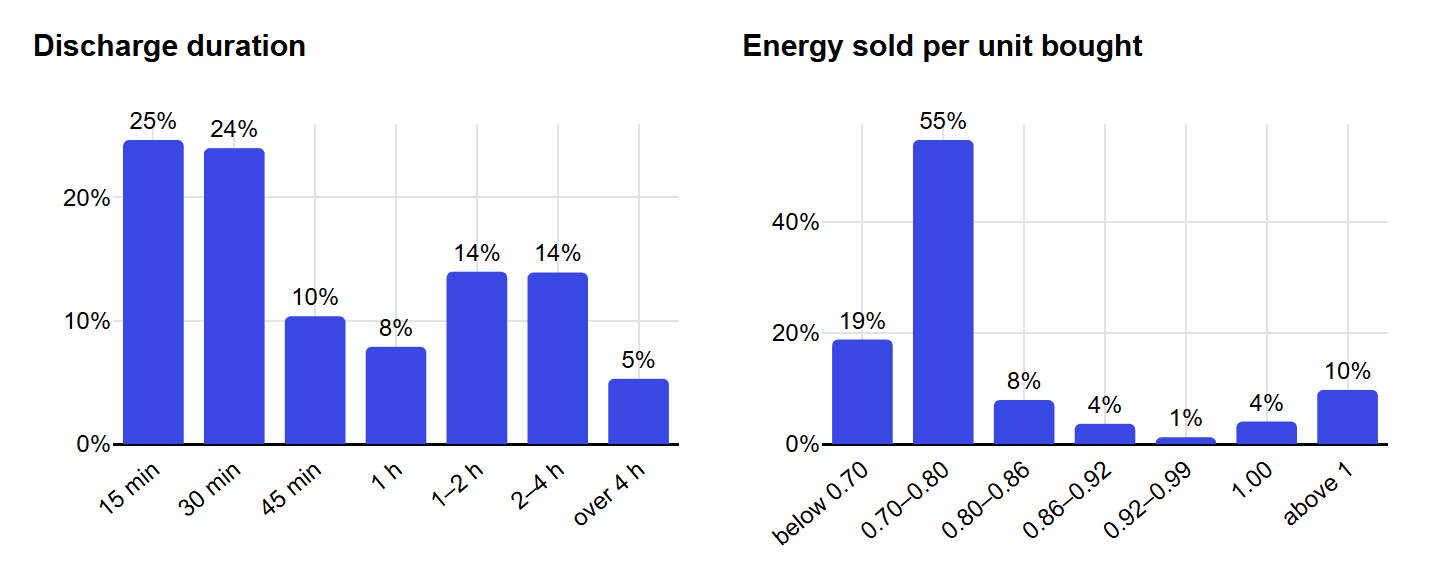
How the loop pairs are shaped: discharge duration and MWh sold per MWh bought, German day-ahead auction, 2026: Real pairs sell 0.70 to 0.80 MWh per MWh bought, well below a typical 86% round-trip efficiency.
The wider the spread, the more loops clear
We grouped the delivery days by the two-hour top-bottom spread of the German day-ahead price and checked the percentage of acceptance of offered blocks.
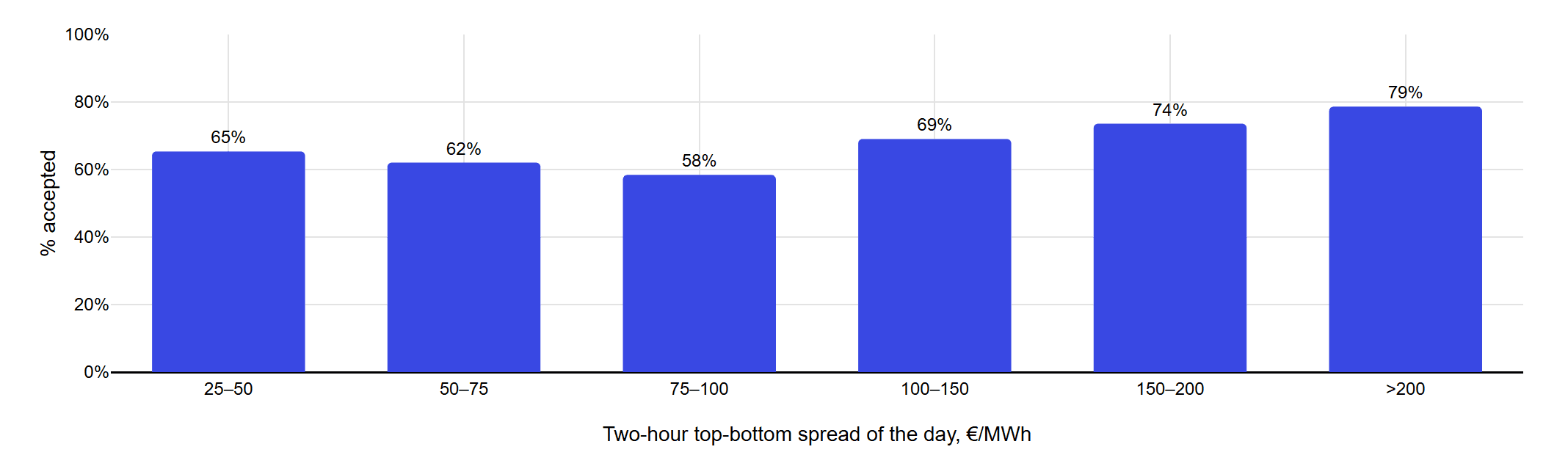
Acceptance against the daily price spread: Acceptance rate rises from 65% on days below with spreads between 25 and 50 €/MWh to 79% above 200 €/MWh.
Spring paid for the year
We calculate the cash flow as sales minus purchases of accepted loop pairs. It peaked in spring: March to June brought 8.1 of the 13.4 M€ net day-ahead cash flow, when the two-hour top-bottom spread stood at 160 to 210 €/MWh.
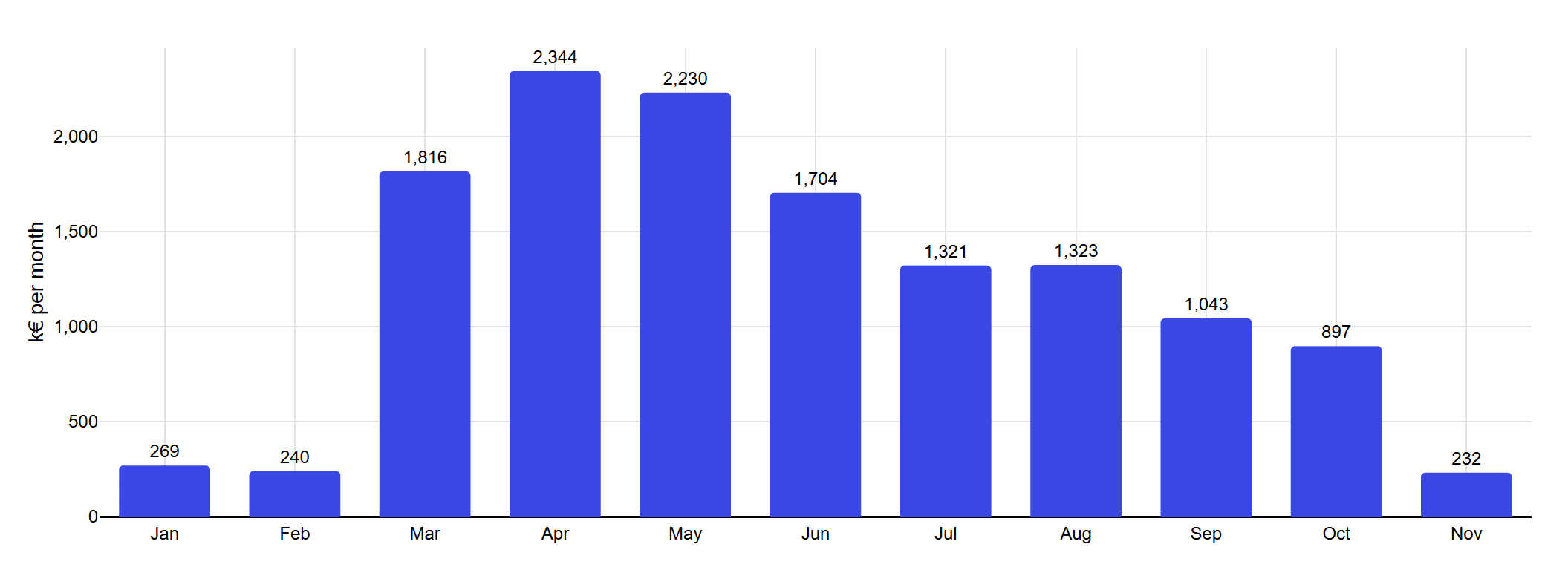
Sales minus purchases of accepted loop pairs per month, k€.
From one forecast curve to 50 scenarios
Volue's SpotEx15 model is the optimal tool to maximize the revenue of your BESS in the day-ahead market. The output of our model is a set of 51 scenarios, generated by an ML model which tracks multiple drivers for each single market and is continuously trained on live inputs. With SpotEx15 scenarios, BESS asset traders gain more confidence that their loop order strategy is really the most profitable one.
Putting SpotEx15 to the test: November 15 to 19
Battery operators in the day-ahead auction must commit, before 12:00 on the day before delivery, to the hours in which they buy and sell.
We tested whether the SpotEX15 50-scenario price forecast from Data & Forecast is a sound basis for that decision and how to measure it.
Method. For each delivery day, the latest scenario run published before 12:00 on the previous day is used (the 11:00 CET run, online between 11:11 and 11:23). The charge and discharge plan with the highest average income over the 50 scenarios is computed for a 100 MW, 200 MWh battery with 86% round-trip efficiency and at most two cycles per day. The plan is split into loop orders, each a buy block linked to a later sell block, with a minimum net income of €5 per MWh sold. The loops are then settled at the realized EPEX quarter-hour prices for Germany-Luxembourg.
Results. All 10 loops offered would have been executed. They would have earned €79,013 over five days. A battery nominated with perfect foresight (perfect knowledge of delivered prices) would have earned €87,301, so the offers captured 91% of the available income.
Offers copied from the prices of the same weekday one week earlier would have earned €66,025, and offers copied from the day before delivery €37,144. The scenarios closed 61% of the gap between the weekly copy and perfect knowledge. Over the last 60 delivery days the same method captured 95%.
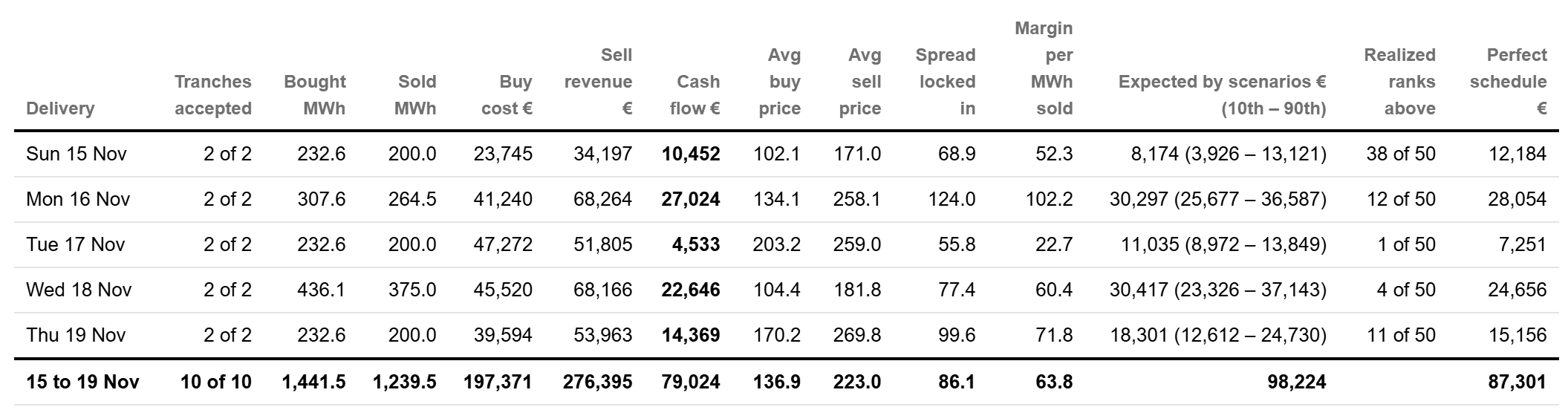
Cash-flow calculation of offered BESS tranches in the spot exchange, following signals from Volue's SpotEx15.
A specific example: Monday, November 16
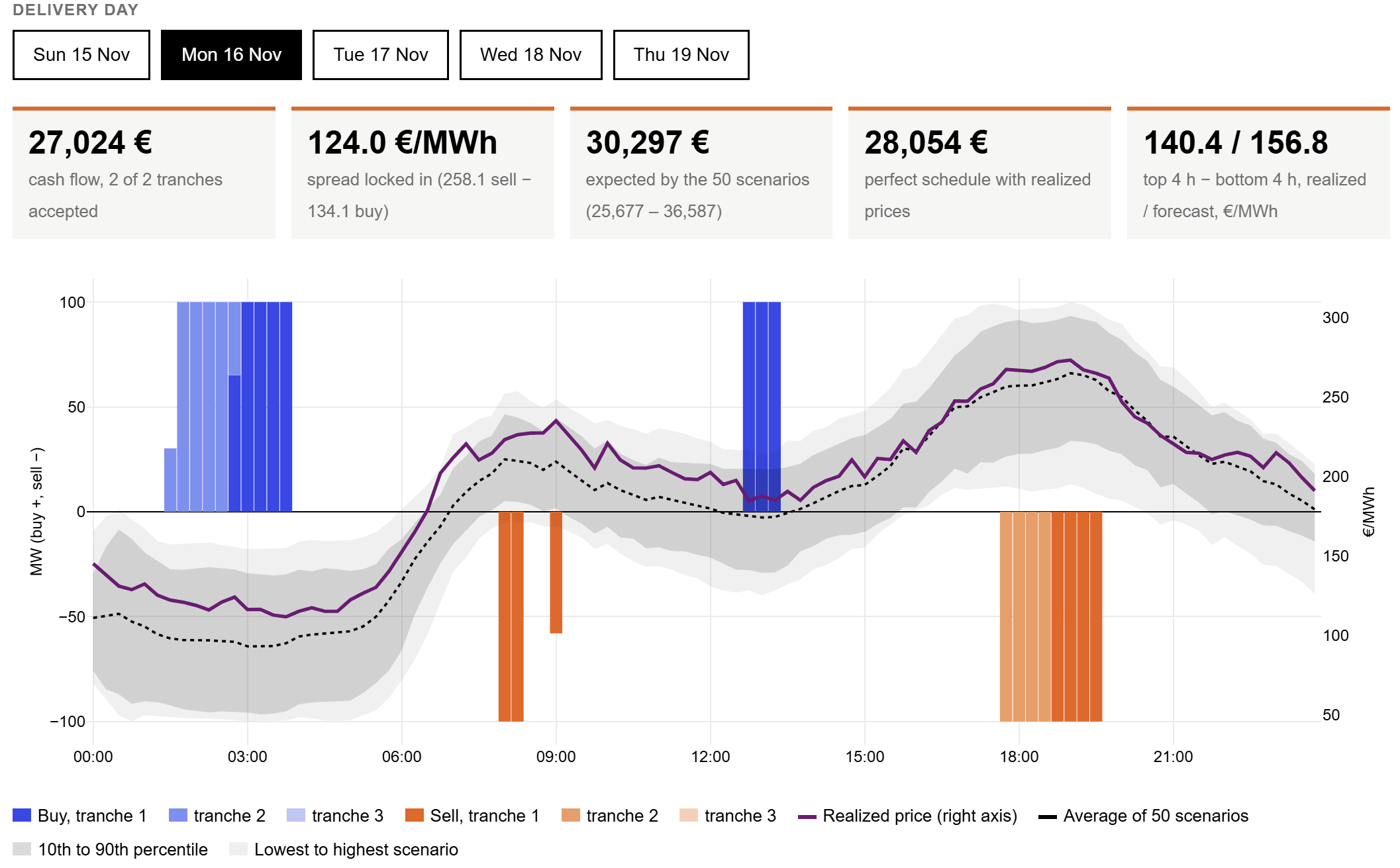
SpotEx15 scenarios, tranche limits and realized German day-ahead prices on November 16, 2026.
Frequently Asked Questions

About the author
Silvia leads Volue’s analysis team for Continental Europe and Japan, where she coordinates a cross-functional team of analysts. She brings more than 25 years of experience in commodity markets, with deep expertise in cross-border trading, flow-based market coupling, and spot price forecasting. Connect with Silvia on LinkedIn.